
The Galerist Journal · workflow
How AI face search changes gallery delivery for your clients
Practical guide for photographers: what face search does to delivery, the risks (privacy, accuracy, law), and a concrete checklist you can use in client contracts and workflows.
Giulio Palumbo Schiavone · September 14, 2026 · 10 min read
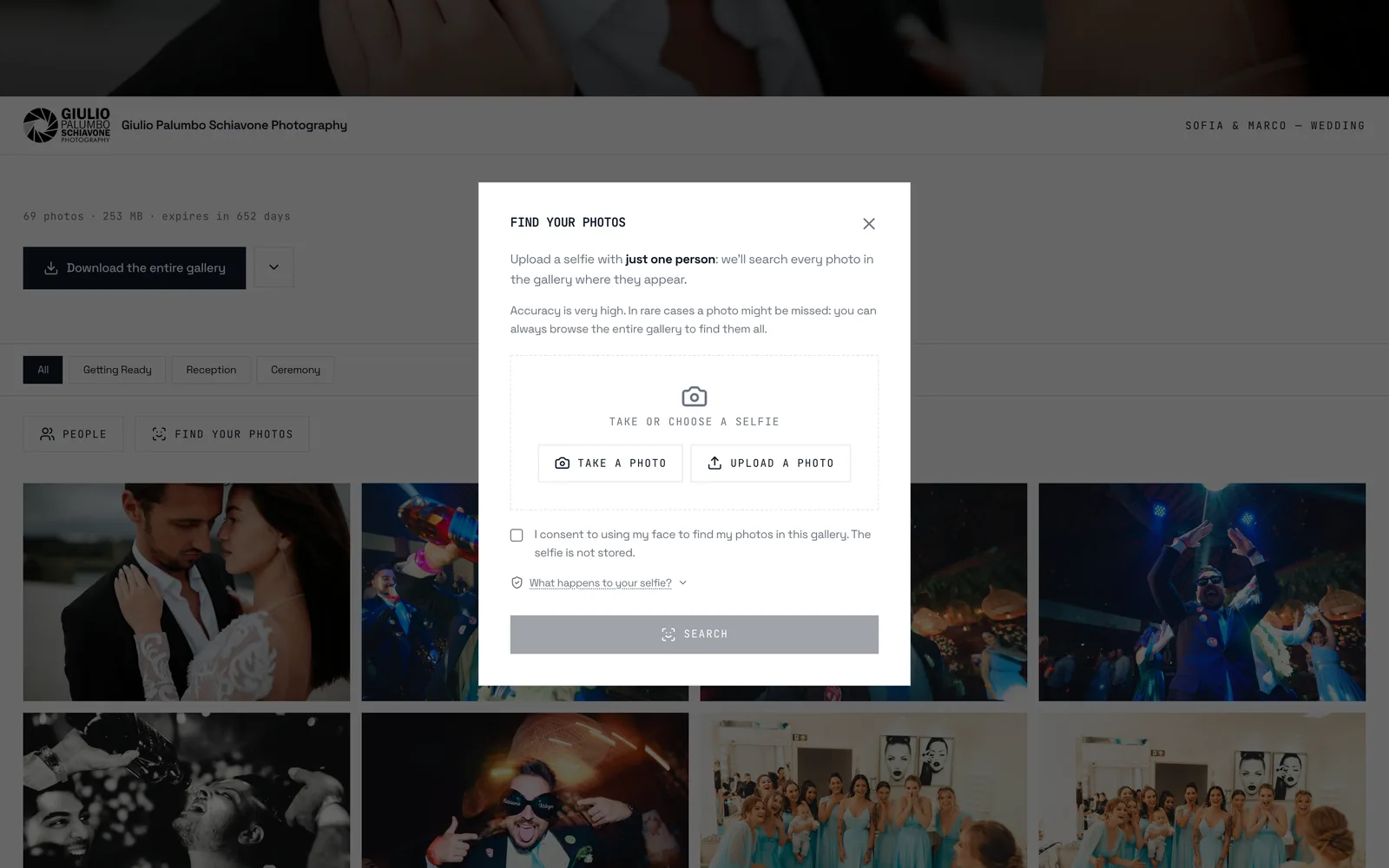
We’ve started seeing face‑search features show up in every gallery and proofing tool the way contact sheets once became standard — quietly, in the background, and then suddenly expected. We make a gallery tool ourselves, so weigh what follows accordingly. From what photographers keep asking us, the practical impact is already clear: face search speeds delivery and upsells, but it also changes the legal and operational work you must do to deliver responsibly.
What "face search" actually buys you
Face search does one thing: it recognises that the same person appears in different photographs, and lets someone pull up every shot they are in. You do not build any of it and you do not tune it — you turn it on for a gallery, or you do not. What the client sees is immediate: one upload, or one tap on a face, and every shot that person appears in — across a whole wedding, event or portrait session — instead of scrolling eight hundred thumbnails to find themselves.
Practically, that means three things a client notices immediately:
- Faster proofs: clients can find themselves, partners, or children in a large gallery in seconds instead of scrolling. This reduces back‑and‑forth and speeds sign‑offs.
- Better upsells: automatic clusters make it trivial to offer framed sets, albums for a specific person, or a child‑only collection — which clients actually buy more often when made obvious.
- Lower admin time: photographers and assistants spend far less time manually tagging and assembling selections.
None of that is theory: it is what the feature does to an afternoon of work, which is the only reason to care about it.
How client expectations shift
Clients begin to expect two things when a gallery claims "face search" or "face grouping":
- Precision — they expect the gallery to find every instance of Aunt Maria or Baby Sam, across dresses and jackets. They assume there will be no false positives. In reality, matching is very good but not perfect.
- Control — they expect the ability to remove images, opt out of auto‑tagging, and control who else can search for their face.
Meeting those expectations is part technical, part process, and part contract.
Accuracy and bias — what to watch for
Face matching systems vary in accuracy and show measurable differences in error rates across demographic groups. Independent testing has documented that many face recognition algorithms have higher false‑positive and false‑negative rates for particular age, sex and race groups; those differences are material in any environment where identification matters. (nvlpubs.nist.gov)
Why that matters for a photographer: a false match in a gallery might tag the wrong person for a print order, or a client might be offended when the algorithm groups two unrelated people together. Assume mismatches will happen and design for easy correction.
Rules and regulations you cannot ignore
AI face search crosses into regulated territory in a few jurisdictions. A few anchor points to keep front of mind:
-
In the EU (and the UK under retained rules), facial images processed to uniquely identify someone are treated as biometric data — a special category that requires an Article 6 lawful basis plus a separate Article 9 condition. That means consent or another narrow legal basis, higher security, and stronger obligations. (eur-lex.europa.eu)
-
In Illinois, the Biometric Information Privacy Act (BIPA) requires written notice and informed consent before collecting or storing biometric identifiers (which the statute defines to include face geometry), and it creates a private right of action for violations — litigants have recovered substantial settlements in recent years. If you do business with Illinois residents, the law matters. (ilga.gov)
-
For children under 13 in the United States, COPPA requires verifiable parental consent before collecting personal information online — and that can include identifiers used by face search. If your product or gallery is directed at or knowingly collects data from children, you must meet COPPA’s requirements. (ftc.gov)
-
The U.S. Federal Trade Commission has also taken enforcement action against companies that misled users about facial recognition features or failed to protect the face data they held; the agency’s public guidance emphasizes transparency, security, and user choice. (ftc.gov)
These are not theoretical risks. They change the checklist you must run through before enabling face search for paying clients.
The decisions that are actually yours
You are not choosing an architecture. You are choosing what to promise, what to charge, and what happens when it goes wrong. Four decisions, and only four:
-
Opt‑in or opt‑out. Choose opt‑in. Opt‑out may be legal where you work, but it means a guest's face gets processed because nobody stopped it, and that is the version you will have to defend to an annoyed parent.
-
Whether you offer it at all on a given job. A corporate event with a press release is not a christening. Some jobs are worth the conversation; on others, turning it off is faster than having it.
-
Who you ask. The person who hired you is not the only person in the photographs. Consent from the couple does not cover the ninety guests, which is why the gallery asking each visitor before it searches their own face does more work than any clause you can write.
-
Whether it costs extra. Running this is not free for whoever provides it, so platforms tend to price it as an add‑on. Decide before the quote whether you absorb it or it appears as a line item — retrofitting a fee onto a delivered gallery is a bad conversation.
Everything else — where the matching runs, what gets stored, for how long — is your platform's decision, not yours. What you owe the client is knowing the answers, and there is a list of the questions further down.
A practical delivery checklist (copy and paste into your SOP)
-
Before the job
- Add a clause in your client contract that explains face search in plain language and asks for explicit consent for indexing and search features.
- Read the consent text your platform already shows visitors, because it is the promise being made in your name. If it does not say plainly whether the selfie is kept, that is the first thing to ask about.
-
When you upload
- If the client accepted, switch face search on for that gallery. If they did not, leave it off — and check that “off” means nothing was processed, not merely that the button is hidden.
-
During proofing
- Tell the client, in the delivery email, that the groups are found automatically and will not be perfect — before they find the mistake themselves.
- Find out what correcting a bad grouping actually involves on your platform. On many — ours included — there is no per‑photo fix: the whole gallery gets re‑analysed, or nothing happens.
-
After delivery
- Before you promise anything about deletion, find out what your platform can actually delete, for whom, and how fast. Most publish nothing on this. Get the answer in writing once, and let it set what your own terms are allowed to say.
- Say in your own terms how long face search stays available on a delivered gallery, and stick to it.
-
Special cases
- Minors: get a parent's consent before a child's face is searchable at all (and follow COPPA rules where applicable for under‑13s). (ftc.gov)
- Sensitive inferences: ask whether the platform infers anything beyond identity — age, mood, ethnicity. The answer should be no, and gallery delivery needs none of it. If it is yes, that is a reason to choose differently, not a setting to go and switch off.
Contract language — short snippets you can adapt
(Non‑legal template; have counsel review.)
-
Consent clause (simple): “We use AI face‑grouping to make it easy to find people in your photos. If you consent, we will create a short numeric face template derived from the images for the sole purpose of grouping, searching and creating personalized products. You may withdraw consent at any time, and we will stop using face grouping on your gallery and pass your deletion request to the platform that holds the data.”
-
Deletion request example: “If you want face grouping removed for you or for someone in your gallery, email privacy@[yourdomain]. We will switch it off for that gallery immediately and ask our provider to delete the underlying data.” — do not write a number of days into this unless your platform has given you one in writing. A deadline you cannot control is a promise you will break.
-
Minors: “For images of children under 18 we will not create face templates unless we have a parent or guardian’s written consent.”
Those are practical starting points — they are not legal advice.
What to ask the platform you use
You inherit your platform's answers to these, and the client will hold you to them, not the platform. Five questions, and what a good answer sounds like:
-
"Is face search off until someone turns it on?" It should be off per gallery, and the visitor should be asked before their own face is searched. "It is on by default for everyone" is the answer to walk away from.
-
"What do you keep, and for how long?" A face turns into a string of numbers to be searchable. Several laws treat that string as biometric data regardless of how small it is, so "we keep it while the gallery is live and delete it after" is a real answer and "we don't discuss our storage" is not.
-
"Does the selfie a guest uploads get stored?" It should not be. If it is, ask why, and for how long.
-
"Can a person be removed?" Not just their photos hidden — their face data gone, on request, within a stated window, with something in writing that says it happened. This is the one you will need on a Tuesday afternoon when somebody calls.
-
"Does it try to infer anything else from a face?" Age, mood, ethnicity, anything. The answer should be no. Inferring those is legally risky in much of the world and buys a gallery nothing.
Write the answers down once. You will be asked them by a client eventually, and "I'd have to check" is a worse answer than any of the above.
Handling mistakes and client disputes
When a client calls to say the gallery mixed two people together, move quickly:
- Apologise and say what you can actually do, which is usually: switch face grouping off for that gallery straight away, and ask your platform to re‑analyse or delete. Do not promise a surgical fix — on most platforms the groups cannot be edited by hand at all.
- If the client threatens legal action, keep logs of consent, the gallery state, and all deletion actions. These logs are your best defence.
- If you operate in multiple jurisdictions, work with counsel to ensure you can meet local deletion/notice obligations.
Acting fast de‑escalates most situations; transparency matters more than technical perfection.
Pricing the service (practical note)
Treat it like any other add‑on. A small fee per gallery, a fee per person searched, or folded into a higher package — all three are normal. Whichever you pick, say it out loud: there is a price for the convenience, and there is a trade‑off in what the guests hand over to get it.
Final, short rules we operate by
- Default to opt‑in. Make the feature compelling, but don’t switch it on without consent.
- Make correction and deletion trivial — clients should never have to fight to remove themselves from an index.
- Don’t try to infer sensitive traits from faces. There is no business need for that in standard gallery delivery.
- Whoever provides the face search is holding that data on your behalf. Get their deletion commitment in writing before you need it.
TL;DR
Face search gets photos to the right person faster and sells more prints, and it hands you accuracy, privacy and legal questions that were not there before. Treat a face as sensitive data: opt‑in by default, ask plainly, get a parent's consent for children, make deletion easy and provable, and refuse anything that infers more than identity. Switching the feature on takes a minute. Deciding what you promise, what you charge, and what you do the day it matches the wrong person is the actual work — and it is the part nobody can do for you.